
// PROJECT · TOOL
Nestra
A Coding Agent Orchestrator — one place to manage providers, models, agents, and routing, with Direct/Routed modes, role-based routing policies, and automatic failover across coding agents.
Overview
I built Nestra because I was tired of manually switching between providers, models, and agent configurations. It is a Coding Agent Orchestrator — one place to manage providers, API keys, models, agents, skills, MCP servers, sessions, and routing. It manages coding agents and, instead of only rewriting a config file, runs a live local gateway that proxies the traffic itself — on-the-fly translation between wire protocols, per-role routing and failover handling.
Role
Solo Developer — Rust backend, React / TypeScript frontend, design system, and build / release.
Features
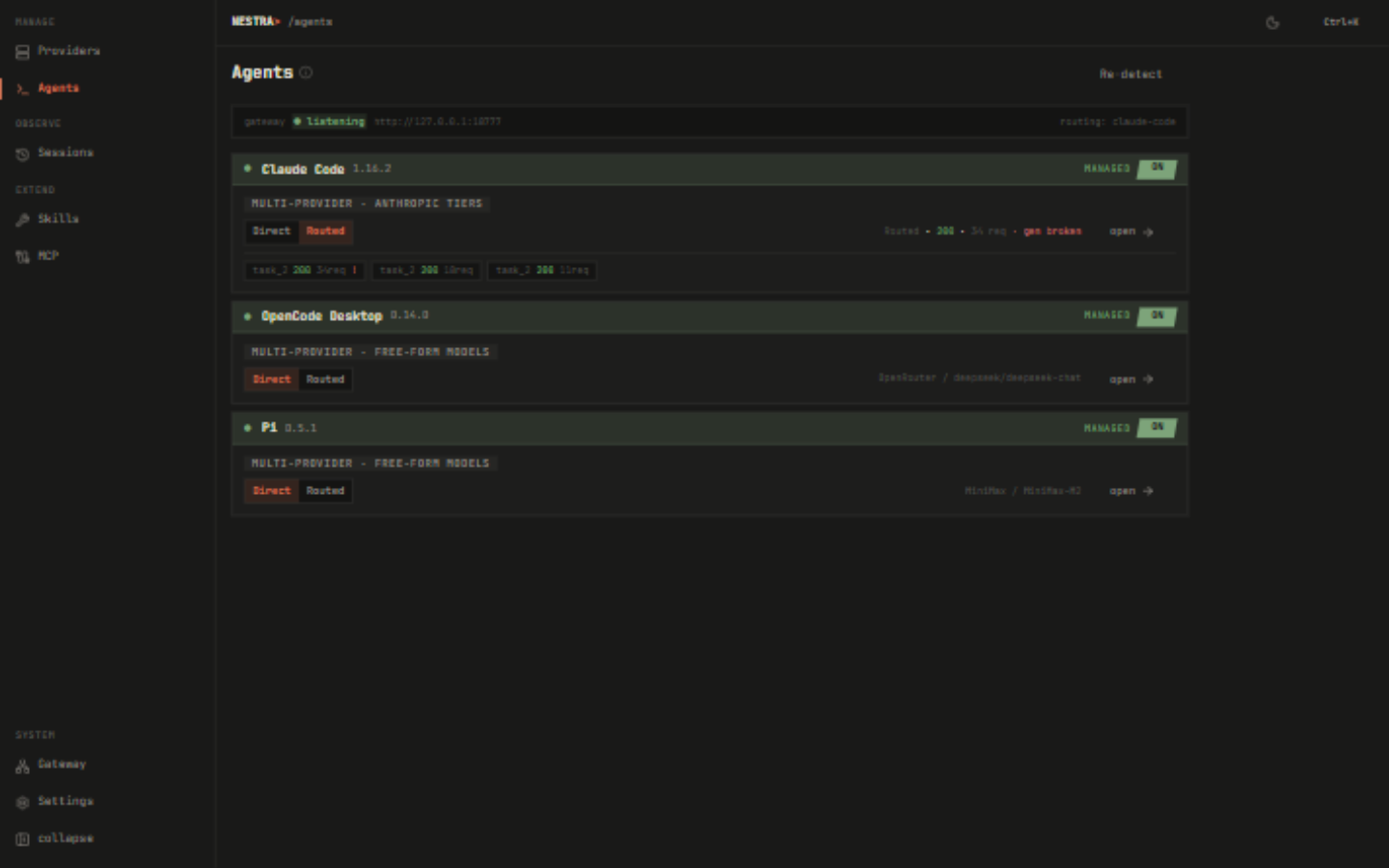
- One control plane for five coding agents. Claude Code, OpenCode, Pi, ZCode, and Codex are detected automatically at launch; providers, API keys, models, endpoints, skills, MCP servers, and sessions are all managed from one app.
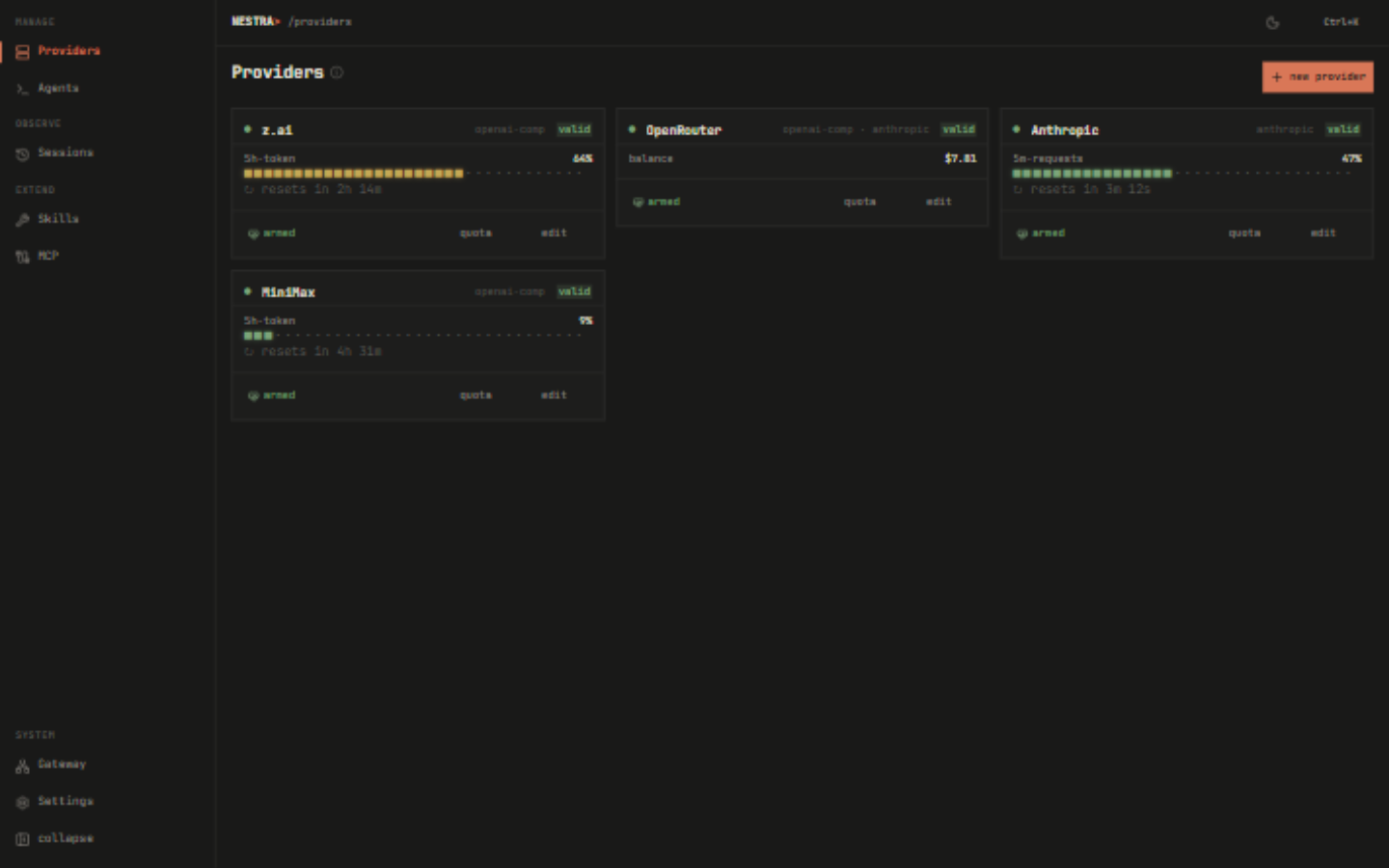
- Provider management. Presets or fully custom endpoints, keys validated on save and encrypted at rest (AES-256-GCM), model selection with per-endpoint ability overrides.
- Direct / Routed modes. Per-agent switch: Direct writes the chosen provider straight into the agent’s configuration; Routed points the agent at a stable local gateway endpoint (
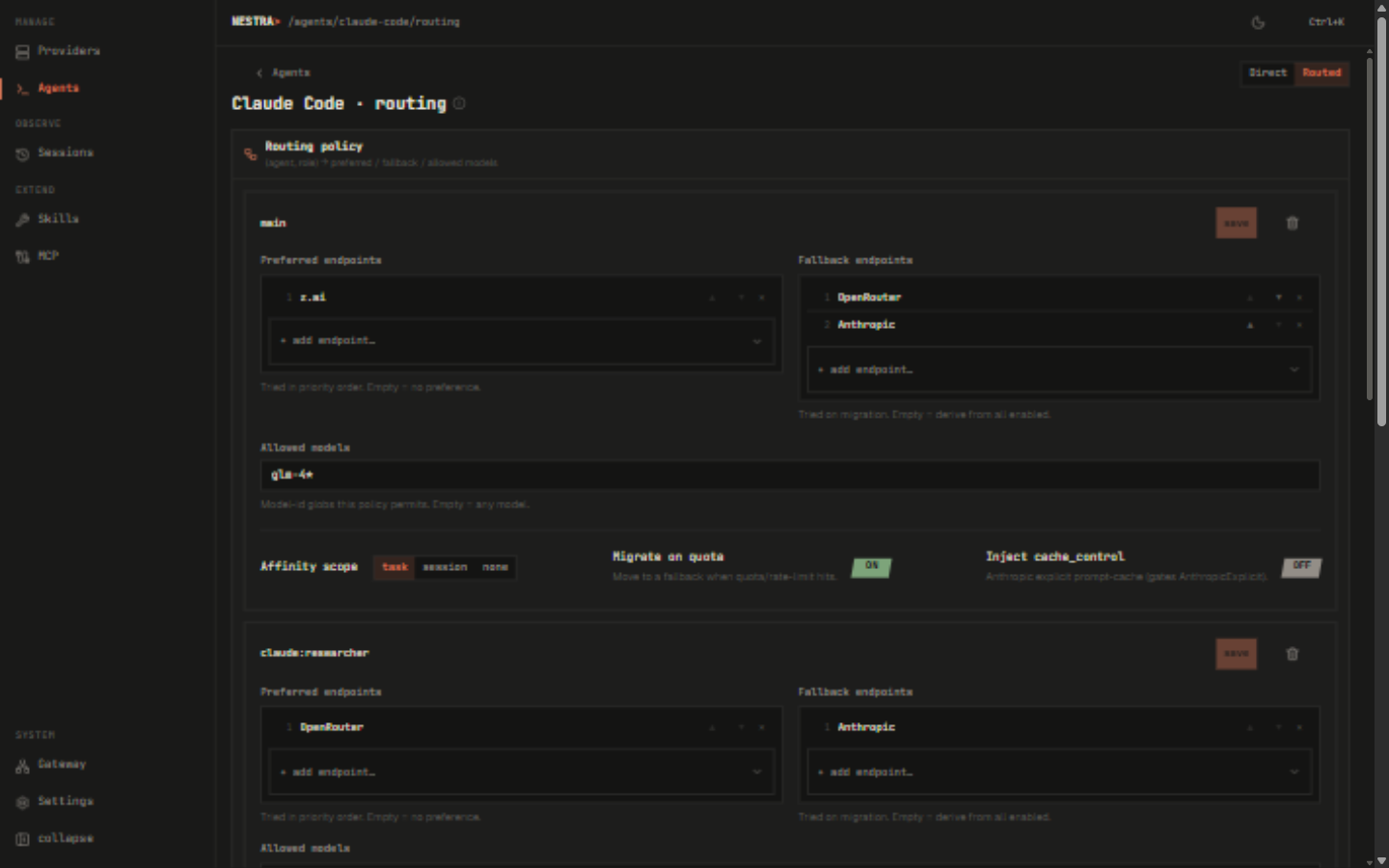
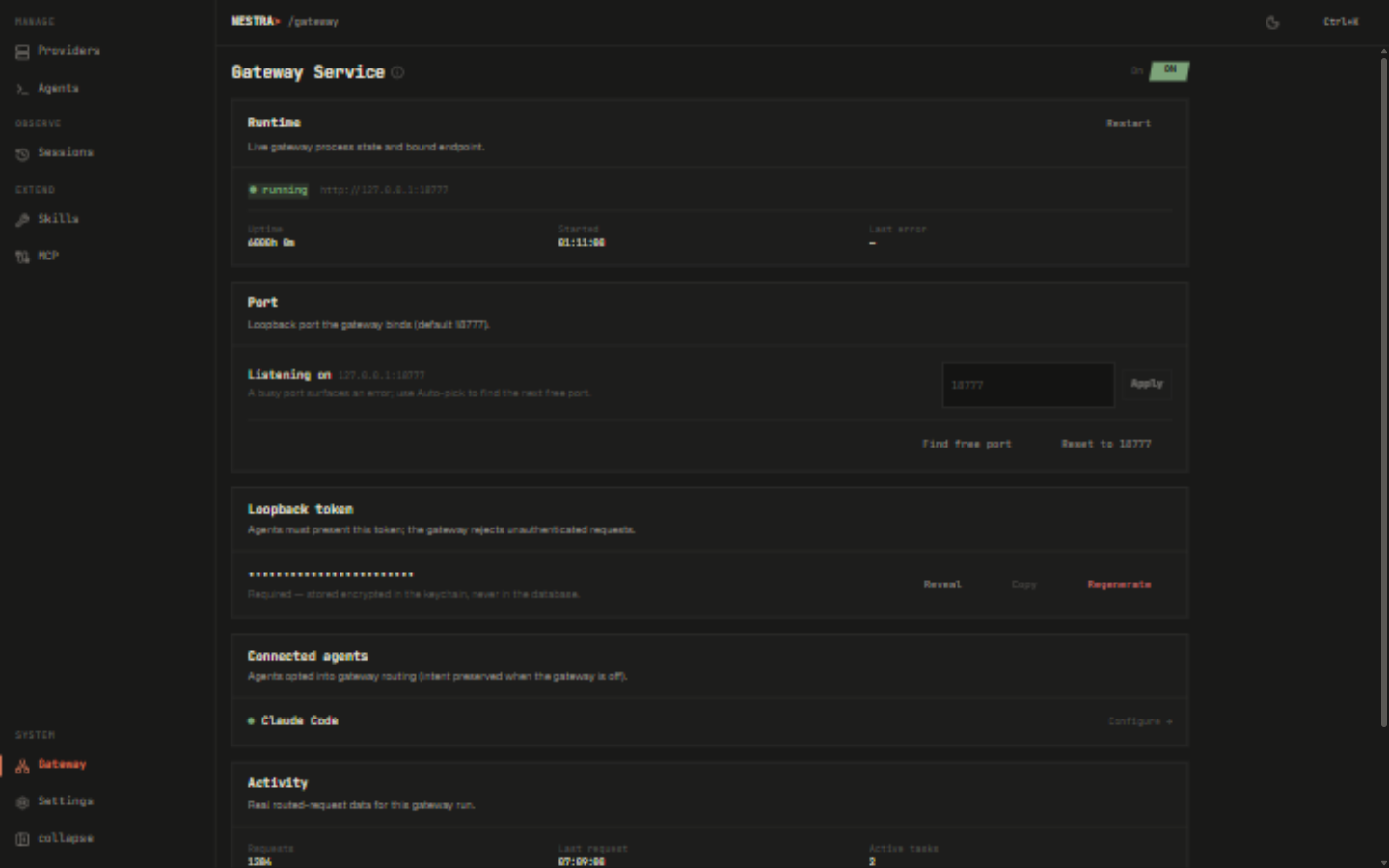
127.0.0.1:18777) instead. - Routing with failover. In Routed mode each request is resolved through an ordered cascade — explicit pin, task affinity, role policy, fail closed. Role policies hold ordered
(endpoint, model)chains per(agent, role), so when a provider hits its quota or a model fails, Nestra moves to the next configured target instead of interrupting the task. - Live activity and session history. Every routed request appears in Activity with its route, model, and token usage, linked to its task; imported session history adds context-pressure estimates and handoff artifacts.
- Skills & MCP sync. Per-agent skill and MCP configuration, managed and synced from Nestra.
Technical Challenges
-
A router I deliberately didn’t want to build. The first design was a pure configurator — write a provider into each agent’s config and step out of the way. That held until real usage needed multi-model coverage: one agent spanning providers to dodge quota windows, a sub-agent pinned to a cheaper model, a fallback when an endpoint starts 429ing. None of that is expressible in a static config file, so the local gateway stopped being optional. The decision was to make the gateway the actual product (Routed mode) and keep Direct mode as the simple, no-proxy path — rather than half-bolt routing onto the configurator and end up with two incomplete implementations.
-
Translating three wire protocols on the fly. Once traffic flows through the gateway, forwarding stops being literal. Claude Code speaks Anthropic Messages; OpenCode and Pi speak OpenAI Chat Completions; the Responses API is a third dialect; and a dual-protocol endpoint like OpenRouter accepts more than one. The gateway converts between them per request — reshape the body across schemas, re-stream the response chunk-by-chunk so the agent’s SSE parser never stalls, rewrite the resolved model id and the usage / cache accounting so each agent sees one consistent upstream, and pick the right wire per (endpoint, model) instead of forcing a single protocol. The agent never learns it isn’t talking to the real provider.
-
Failover that admits when a turn was broken. When a provider exhausts quota mid-task the router migrates to a fallback while preserving the
task_id, but it stampsgeneration_brokenhonestly instead of dressing the retry up as a seamless continuation. The agent is told the truth — this turn resumed on a different provider and the prompt cache didn’t carry — because routing that lies about interruptions is worse than no routing at all.
 // PREVIOUS · WEB
ForzaDrift
// PREVIOUS · WEB
ForzaDrift
 // NEXT · WEB
Phosphor
// NEXT · WEB
Phosphor