// PROJECT · WEB
ForzaDrift
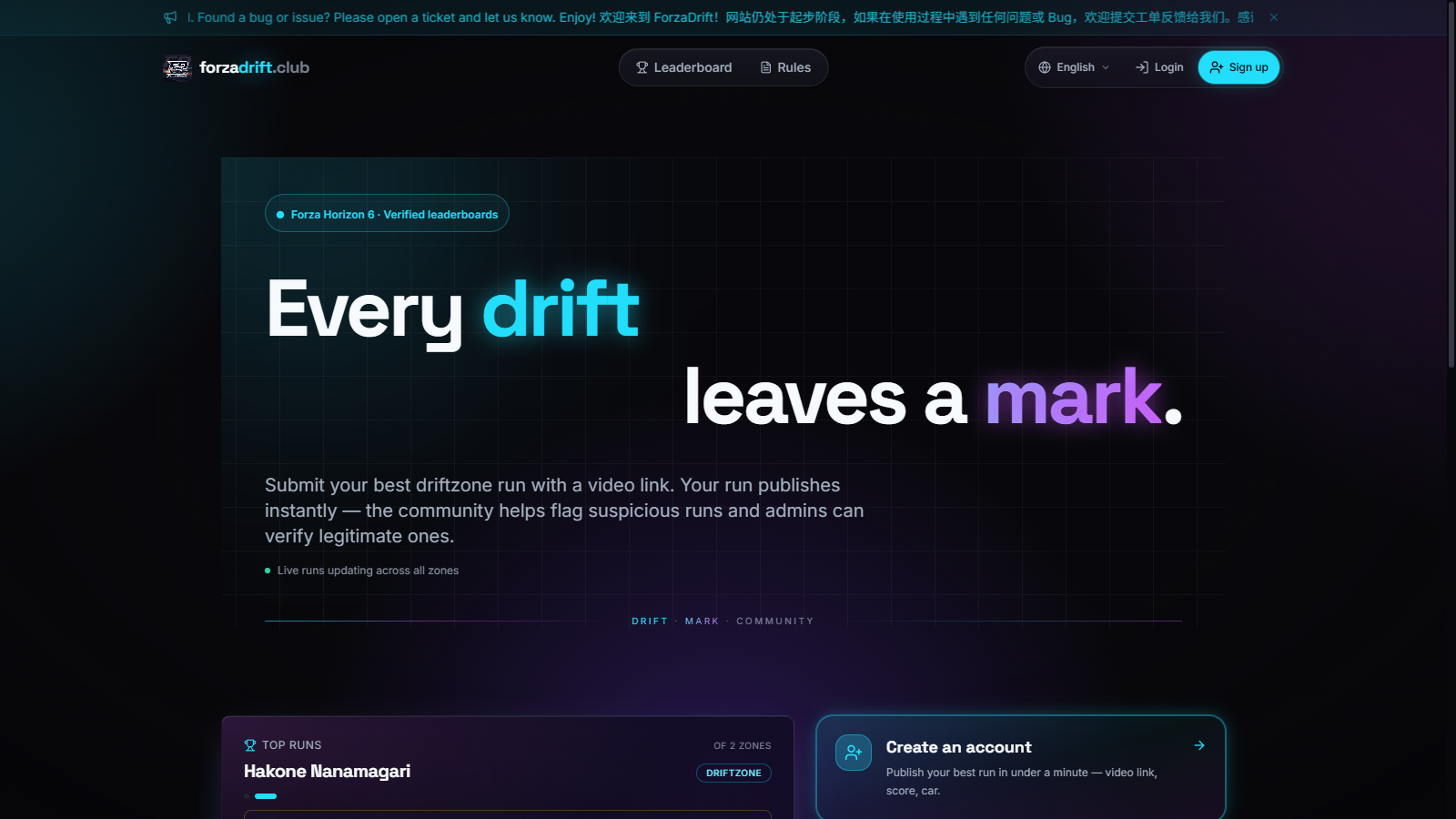
Community-driven Forza Horizon 6 drift leaderboards (Next.js/PostgreSQL) - submit a run with a video link, community-verifies the score.
ForzaDrift is a full-stack community leaderboard platform for Forza Horizon 6 drift zones and circuits. A run publishes to the board the moment it’s submitted with a video link; the community then flags suspicious scores for admin review, and legitimate runs earn a verified badge after the fact. Built and deployed solo, live at forzadrift.club.
Role
Solo Developer - full-stack, design, DevOps
Contributions
- Built the entire platform end-to-end on Next.js with PostgreSQL + Prisma — full-stack, design and DevOps solo.
- Built the auth and anti-abuse stack — NextAuth.js credentials, a hand-written per-action rate limiter, and dual bot protection (Cloudflare Turnstile + a self-hosted proof-of-work fallback), geo-routed at the edge.
- Designed the data model around drifters, zones, runs, community reports, tickets and an audit log, and built the dual-mode record review — a runtime publish / review toggle over a unified submission lifecycle, plus the community reporting workflow around it.
- Shipped bilingual EN / 中文 support end-to-end.
- Wrote the deployment pipeline — Docker Compose + Cloudflare Tunnel, branch-per-environment strategy, periodic database snapshots and JSON data exports with retention.
Technical Challenges
-
Anti-abuse as a first-class concern. Rate limiting, CAPTCHA and auth hardening shipped from day one rather than as add-ons - per-action rate limits with bucket cleanup, bcrypt-hashed credentials with on-login rehashing for legacy weak hashes, generic login errors so attackers can’t probe which field collided, and a fail-closed boot guard that aborts startup if any auth secret is missing or still a placeholder.
-
CAPTCHA that works in every region. Cloudflare Turnstile is the primary challenge, but it’s unreachable from parts of the world. I added a self-hosted Altcha proof-of-work fallback that the browser solves in Web Workers and the server re-verifies, with edge middleware routing each visitor to the right provider by country, so the app works globally without depending on a third party for the fallback path.
-
Auth that can be revoked on demand. Sessions are stateless JWTs but still revocable through a per-user version counter that invalidates every outstanding token at once, with generic login errors and a per-request nonce-based content security policy layered on top.
-
Runtime policy switches without a redeploy. Records run in either a
publishmode (live the moment they’re submitted) or areviewmode (hidden until an admin verifies them), and an admin flips between the two from a settings page with no rebuild. The key decision was decoupling the submission lifecycle (fixed) from the visibility policy (read from the database at query time) - so switching modes takes effect on the very next request and never touches existing rows. -
Soft-delete that just works, including resubmits. A Prisma client extension rewrites deletes into soft updates and auto-appends a tombstone filter to reads, with an opt-out for the trash view. Because the rewrite can’t change the operation type, it routes through the base client captured by closure to dodge recursion, and a partial unique index enforces “one row per slot” while excluding tombstones so a user can delete and resubmit without races.
Lessons Learned
- Plan the data model for the features you might pivot to. Records started in verify-must mode — every run gated behind admin review. The site later flipped to publish-first, then realized both modes were needed, selectable at runtime. Each pivot forced a status-enum backfill and the schema still carries legacy values kept only so old rows and audit logs keep resolving. What finally stuck: model the submission lifecycle (a status) separately from the visibility policy (a mode setting read from the DB), so the policy can change without ever touching the data.
- Building the simple rate limiter first and naming its upgrade path in code taught me to ship the boring solution and document the ceiling, rather than over-engineer for scale that hadn’t arrived.
Live: forzadrift.club
 // NEXT · TOOL
Nestra
// NEXT · TOOL
Nestra